Introduction
Air fryers have become genuinely useful kitchen tools rather than the novelty appliances they were initially dismissed as — but as the category has matured, the differences between models have become increasingly meaningful. The gap between a basic 4-quart air fryer and a well-engineered 6.5-quart machine with higher temperature capability isn’t just a numbers difference. It translates into real cooking outcomes: more food cooked simultaneously, crispier results at higher heat, and a broader range of techniques available from a single countertop appliance.
The Ninja AF181 XL Air Fryer sits at the larger, more capable end of Ninja’s standard basket air fryer lineup. The 6.5-quart capacity, 450°F maximum temperature, and MaxCrisp technology represent meaningful steps beyond the AF101 and AF141 models — not incremental marketing upgrades, but genuine capability additions that change what the appliance can do and how it performs at the edge of its function set.
This article examines the AF181 in full — what each of its six functions offers in real cooking situations, who benefits most from the larger capacity and higher heat, what’s worth understanding about its limitations, and how it positions against the broader air fryer market.
What Is the Ninja AF181 XL Air Fryer?
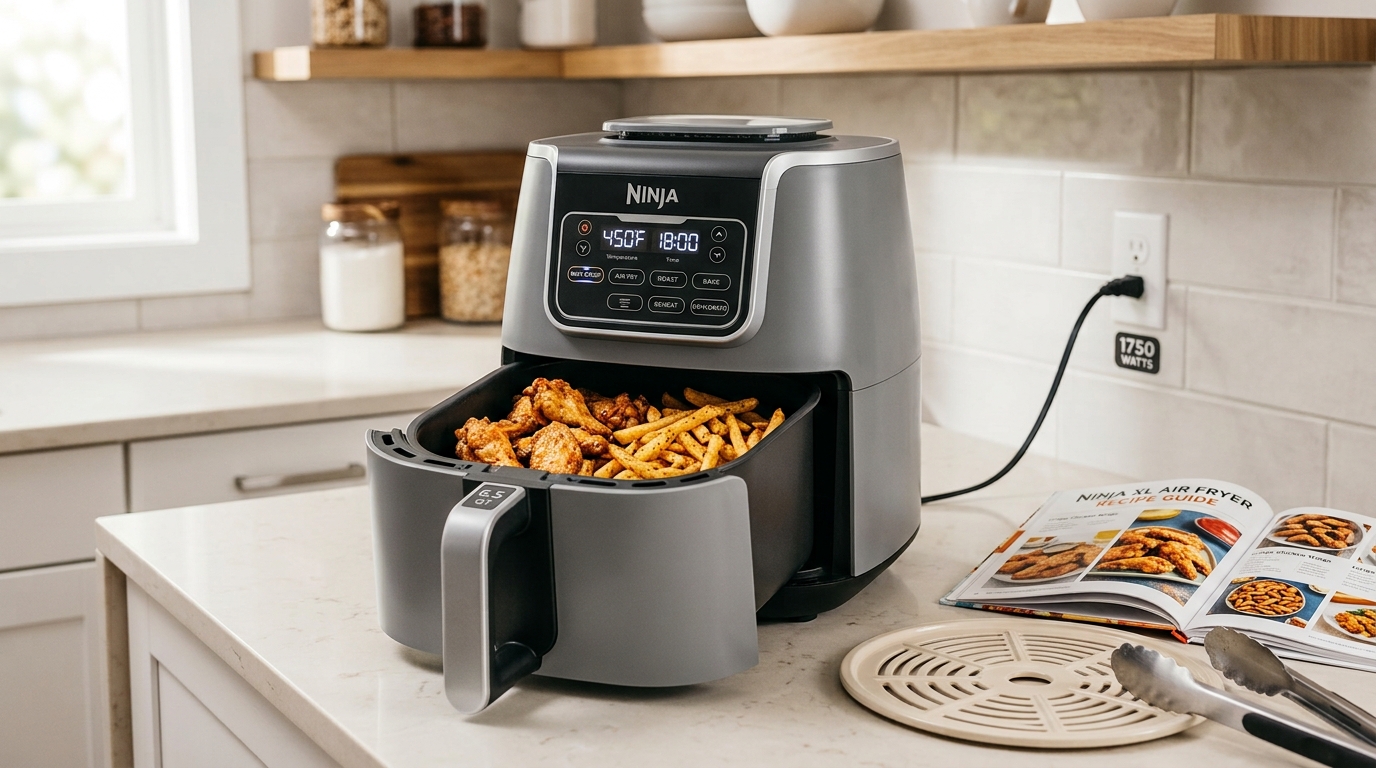
The AF181 is the XL iteration of Ninja’s basket air fryer format, pushing capacity to 6.5 quarts and maximum temperature to 450°F while maintaining the six-function design that covers the practical range of what most households need from a countertop air fryer. The MaxCrisp function is the headline addition that distinguishes this model from standard Ninja air fryers — a high-heat, high-airflow mode specifically engineered for maximum surface crisping rather than the balanced approach of the standard Air Fry setting.
It operates at 1,750 watts, includes a nonstick basket and crisper plate, and ships with a recipe guide that provides starting points for new users across all six functions. The grey exterior continues Ninja’s neutral aesthetic approach that suits most kitchen environments without demanding visual attention.
Key Features of the Ninja AF181 XL Air Fryer
MaxCrisp Technology at 450°F
The MaxCrisp function and the 450°F temperature ceiling are the two features that most clearly differentiate the AF181 from Ninja’s lower-tier basket models, and understanding them together explains why the distinction matters.
Most consumer air fryers top out at 400°F. That temperature is adequate for the majority of everyday air frying — chicken wings, fries, roasted vegetables, reheated leftovers. But there’s a category of cooking results where the additional 50 degrees between 400°F and 450°F produces a noticeably different outcome: maximum surface crisping for foods where the distinction between properly crispy and genuinely crunchy matters most.
Frozen french fries, for instance, develop better exterior crunch at 450°F than at 400°F — the additional heat drives more rapid surface dehydration and Maillard browning in the outermost layer that produces the distinct snap of a properly crisped fry. Chicken skin goes from crispy to genuinely crackling at higher temperatures. Breaded items develop more pronounced crunch. Foods that hover at the edge of properly done at 400°F resolve clearly at 450°F.
MaxCrisp combines this maximum temperature with what Ninja describes as optimized high-airflow settings — essentially, the fan and heating element working together at their maximum capacity specifically for crisping applications rather than the balanced approach that the standard Air Fry function uses for broader cooking applications.
For households that specifically want the crispiest possible results from their air fryer — people who have found other machines produce food that’s good but not quite crunchy enough — MaxCrisp and the 450°F ceiling are the AF181’s most compelling selling points.
6.5-Quart Capacity
The 6.5-quart basket is the largest capacity available in Ninja’s standard single-basket format, and the half-quart difference from the AF141’s 5-quart basket and the full 2.5 quarts over the AF101’s 4-quart basket translate into meaningful cooking quantity differences.
In practical terms, the 6.5-quart basket accommodates a larger batch of chicken wings than the smaller models — closer to a full pound and a half per layer rather than a pound. It fits more vegetables for a family-sized roasted vegetable side dish in a single load. It handles a generous portion of fries for four to five people without the overcrowding that smaller baskets require for comparable quantities.
Overcrowding is the persistent enemy of good air fryer results. When food is packed too tightly, airflow between pieces is restricted, steam builds up rather than escaping, and the result is food that steams rather than crisps. The 6.5-quart basket provides more room for proper airflow around individual pieces in family-sized batches — which means more consistent crisping across the whole batch rather than the outer pieces doing well while the interior pieces remain pale.
For households of four to five people who cook family-sized portions regularly, the AF181’s capacity handles these quantities more comfortably in a single load than smaller models, with less compromise in air circulation quality.
Six Cooking Functions
MaxCrisp is the headlining function and the most temperature-aggressive option in the AF181’s repertoire. At 450°F with maximum airflow, it’s specifically calibrated for applications where surface crunch and crispness are the primary goals — frozen fries, breaded items, chicken skin, and similar foods where maximum heat produces noticeably better texture than standard air frying temperatures.
Air Fry provides the balanced high-heat cooking approach suited to the broadest range of everyday applications. Chicken pieces, fish, shrimp, vegetables, and the general range of foods that air frying handles well all go through the Air Fry function, which produces excellent crisping results without the very high temperature of MaxCrisp that can push delicate foods past their ideal doneness.
Roast applies measured heat over appropriate durations for denser foods that need to cook through at controlled temperatures before the exterior reaches the right color. Chicken thighs, pork tenderloin, salmon fillets, and similar proteins roast well in the AF181’s Roast function — comparable to oven roasting results in substantially less time, with less energy consumed and no preheating a full-size oven.
Bake extends the AF181 into small-scale baking applications that single-function air fryers can’t address. Muffins, individual cakes in appropriately sized pans, cookies, and similar small-batch baked goods fit in the 6.5-quart basket with air fryer-compatible baking accessories. For occasions when heating a full-size oven for a small quantity of baked goods feels disproportionate, the Bake function provides the alternative.
Reheat addresses one of the most consistently appreciated air fryer capabilities — bringing leftover food back to proper temperature with restored texture rather than the steamed-soft results microwave reheating produces. The Reheat function on the AF181 handles this well across the range of texture-sensitive leftovers that benefit most from it: pizza with a properly re-crisped base, fried chicken that regains most of its original crunch, pastries and breaded foods that microwave reheating destroys.
Dehydrate uses sustained low heat — the AF181’s lower temperature range — to remove moisture from food over several hours. Beef jerky, fruit chips, dried herbs, and vegetable crisps are all achievable through the Dehydrate function. The 6.5-quart basket provides more surface area for single-layer dehydration than smaller baskets — a practical advantage for jerky making where pieces need adequate spacing for even moisture removal.
1,750 Watts
The 1,750-watt power rating provides the heating capacity needed to reach 450°F reliably and maintain temperature throughout a cooking cycle, particularly during the MaxCrisp function where sustained maximum heat is the point. This wattage level also supports fast preheat — the AF181 reaches cooking temperature quickly, which reduces total cooking time from cold start to finished food.
Standard household outlets handle 1,750 watts without issue, though running the AF181 simultaneously with other high-draw kitchen appliances on the same circuit is worth being mindful of to avoid tripping breakers.
Nonstick Basket and Crisper Plate
The cooking surfaces that contact food — the basket and the crisper plate that elevates food above the basket floor — are both nonstick coated. This serves two distinct practical purposes.
Food release is the first. Proteins that can bond to cooking surfaces during high-heat cooking, sticky glazes that caramelize during air frying, and cheese that melts and adheres to cooking surfaces all release more cleanly from nonstick surfaces than from uncoated alternatives. This reduces the frustration of food sticking and tearing when removed from the basket after cooking.
Cleanup is the second. Nonstick surfaces clean more easily than uncoated ones — residue wipes away with a soft sponge and mild soap rather than requiring scrubbing that would be needed to remove baked-on food from bare metal. For a daily-use appliance, this cleanup efficiency accumulates into meaningful time saved over hundreds of cooking sessions.
The nonstick coating requires reasonable maintenance to preserve — no metal utensils inside the basket, no abrasive scrubbing pads, and ideally hand washing rather than dishwasher cycles for the cooking surfaces. Following these care practices extends the coating’s useful life significantly.
Included Recipe Guide
The recipe guide included with the AF181 provides a practical starting point for new users across all six functions, with specific time and temperature guidance developed for this appliance. For someone new to air frying — or new to the MaxCrisp function specifically — the recipe guide provides calibrated starting points that produce good initial results and form the basis for personal adjustment based on experience and preference.
How the Ninja AF181 Can Be Used
Maximum Crispness Applications with MaxCrisp
The MaxCrisp function earns its name for a specific category of cooking results that the AF181’s temperature ceiling makes possible in ways that 400°F air fryers can’t fully replicate.
Frozen french fries are the most direct example. At 450°F with MaxCrisp airflow, frozen fries develop the exterior crunch that distinguishes a genuinely well-cooked fry from a pale, soft version. The high heat drives rapid surface dehydration and Maillard reaction that creates the distinct outer texture. Results are noticeably better than the same fries cooked at standard air fryer temperatures.
Chicken wings with properly crisped skin respond similarly. The difference between crispy chicken skin at 400°F and at 450°F is perceptible — higher heat produces skin that approaches the crackled, fully rendered texture of deep-fried wings in a way that lower temperatures only approximate.
Breaded proteins — cutlets, breaded fish, schnitzel-style preparations — develop more pronounced crunch at 450°F than at 400°F. The breading browns more aggressively and sets more completely, producing a crust that stays crunchy rather than softening as the food rests.
Family-Sized Everyday Air Frying
For a family of four to five people eating together, the AF181’s 6.5-quart basket handles the quantities that come up in family cooking without the multiple rounds that smaller baskets require. A full family dinner’s worth of chicken thighs, a generous vegetable side dish for five people, enough wings for everyone at game night — these quantities fit in the AF181 in ways that a 4-quart basket genuinely can’t accommodate in a single load.
The airflow design’s ability to maintain proper circulation in a filled 6.5-quart basket — rather than the restricted airflow that comes from overcrowding a smaller basket with comparable quantities — means the quality of results with family-sized batches is more consistent than squeezing those quantities into a smaller machine.
Roasting Complete Protein Portions
Weeknight protein cooking is where the AF181’s Roast function earns consistent daily use. Chicken thighs for four people in 22 minutes. Salmon fillets for a family in 12 minutes. Pork chops with a properly browned exterior in 15 minutes. These cooking times are 30 to 50 percent shorter than conventional oven equivalents, with no oven preheating time and less energy consumed.
The 6.5-quart capacity handles larger protein portions without the crowding that smaller baskets impose — four full chicken thighs with adequate spacing produce better results than four thighs crammed into a 4-quart basket where airflow between pieces is compromised.
Reheating at the Family Scale
Reheating leftovers for multiple people simultaneously benefits directly from the AF181’s capacity. Four to five portions of pizza come out crispy-based simultaneously rather than in two rounds. Enough leftover chicken for a family lunch reheats together. This might seem like a minor point, but the daily friction of waiting for multiple reheating rounds for what should be a quick meal adds up over time for households that eat leftovers regularly.
Producing Perfectly Roasted Vegetables at Volume
Roasted vegetables are among the most reliably excellent air fryer outputs at any temperature, and the AF181’s larger basket and higher temperature ceiling both contribute to better results than smaller, lower-temperature machines produce.
More basket space means vegetables can be spread in a closer-to-single layer — the configuration that produces the best roasting results, with hot air contacting all surfaces rather than only the top layer of a pile. Higher temperature ceiling means the caramelization and slight charring at the edges that makes roasted vegetables so satisfying develops more aggressively, in less time, than at 400°F.
Broccoli, Brussels sprouts, asparagus, cauliflower, green beans, cherry tomatoes — all of these roast excellently in the AF181, developing the browned exterior and slightly caramelized flavor that makes air-roasted vegetables satisfying enough to eat consistently.
Making Homemade Jerky and Dehydrated Snacks
The Dehydrate function’s value is clearest for households that regularly purchase jerky or dried fruit snacks and want to make them at home for cost savings and ingredient control. The 6.5-quart basket accommodates a meaningful quantity of jerky strips or fruit slices per dehydration session — more surface area than smaller baskets, which matters for even moisture removal during the several-hour dehydration process.
Beef jerky marinated and seasoned to personal preference, apple chips, mango slices, banana chips, and similar snacks are achievable through the Dehydrate function at a per-batch cost significantly lower than commercial equivalents.
Who the Ninja AF181 May Be Suitable For
Households of Four to Five People
The 6.5-quart basket is the primary reason to choose the AF181 over smaller Ninja models for larger households. Cooking family-sized portions in a single load rather than multiple rounds changes the practical experience of using the air fryer for daily cooking. For families that eat dinner together regularly and want the air fryer to handle full family-meal quantities, the AF181 is proportioned for that use case in a way that 4 and 5-quart models aren’t.
People Who Prioritize Maximum Crispness
The MaxCrisp function and 450°F ceiling are specifically for people who find standard air fryer results good but not crispy enough. For frozen fry enthusiasts, chicken skin devotees, and anyone who specifically wants the crunchiest possible texture from their air fryer, the AF181’s temperature advantage over 400°F models produces perceptibly different and preferred results.
Households Upgrading from Smaller Air Fryers
For someone who bought a 4-quart entry-level air fryer, found themselves consistently running multiple batches for family meals, and wants an upgrade that solves that specific problem, the AF181’s capacity directly addresses the limitation that drove the upgrade decision.
Regular Entertainers and Home Hosts
For households that regularly host gatherings where air-fried food is served — game nights with wings, parties with appetizers, casual dinner parties where crispy sides are part of the menu — the capacity and MaxCrisp capability of the AF181 handle entertaining quantities and quality expectations better than smaller models.
People Making Homemade Dehydrated Snacks Regularly
For households that make jerky or dried fruit regularly enough to justify dedicated dehydration sessions, the AF181’s larger basket produces meaningful batch quantities per session compared to smaller-basket alternatives.
Important Things to Consider
Counter Space and Cabinet Clearance
A 6.5-quart air fryer is a substantial countertop appliance. The AF181 requires meaningful counter real estate and — importantly — adequate overhead clearance for the basket to open and extend fully during use. Standard overhead kitchen cabinets positioned close to the counter can interfere with the basket’s opening range if the appliance is positioned directly beneath them. Measuring both footprint space and overhead clearance before positioning the AF181 prevents the frustration of finding it doesn’t function properly where you intended to put it.
MaxCrisp’s High Heat Isn’t Right for Everything
The 450°F MaxCrisp function produces exceptional results for foods that specifically benefit from maximum heat crisping. It’s not the right setting for delicate proteins, foods that need to cook through at measured temperatures before the exterior is done, or any application where the concern is thorough internal cooking rather than surface crisping. Using MaxCrisp indiscriminately produces overbrowned exteriors on foods that needed more moderate heat — understanding which applications benefit from MaxCrisp versus standard Air Fry or Roast settings is part of getting the best results from the AF181.
Nonstick Coating Maintenance
The nonstick coating performs best with appropriate care. Metal utensils scratch the surface and accelerate coating degradation. Abrasive scrubbing pads damage the nonstick surface. Dishwasher cycles, while technically survivable for some nonstick surfaces, degrade the coating faster than hand washing. Establishing gentle care habits from the first use — silicone or wooden utensils, soft sponge cleaning, hand washing — extends the coating’s effective life through years of daily cooking rather than months.
Learning Which Function to Use When
Six functions offer genuine versatility, but getting the most from that versatility requires developing understanding of which function produces the best results for specific foods. MaxCrisp for frozen fries and maximum-crunch applications. Air Fry for general cooking. Roast for denser proteins that need to cook through. Reheat for leftovers. Dehydrate for moisture removal. Bake for small-batch baking. This understanding develops through use over the first several weeks of ownership and becomes second nature quickly — but the initial experimentation period is worth anticipating.
Smoke from Fatty Foods
High-heat cooking of fatty foods produces smoke as fat drips and heats — this is normal and not specific to the AF181, but at 450°F the smoke production is more pronounced than at lower temperatures. Adding a small amount of water to the bottom of the basket beneath the crisper plate reduces smoking from dripping fat. Ensuring the basket is cleaned of accumulated grease between uses also minimizes smoke during subsequent cooking sessions. Good kitchen ventilation during high-heat cooking with fatty foods is always recommended.
How the Ninja AF181 Compares to Other Options
AF181 vs. Ninja AF141 (5-Quart)
The AF141 is the natural predecessor in Ninja’s lineup — 5 quarts versus 6.5 quarts, 400°F maximum versus 450°F, without MaxCrisp. For households of three to four people whose primary interest is everyday air frying without specific maximum-heat requirements, the AF141 provides comparable quality in a slightly smaller and typically less expensive package. The AF181’s advantages become clearest for larger households consistently cooking in quantities that push a 5-quart basket’s limits, and for users who specifically want MaxCrisp’s higher temperature capability.
AF181 vs. Ninja AF101 (4-Quart)
The AF101 is Ninja’s entry-level air fryer — 4 quarts, 400°F, four functions. The AF181 represents a substantial step up in capacity, temperature, and function count. For small households of one to two people primarily air frying for themselves, the AF101’s smaller footprint and lower price point make more sense. For families or anyone regularly cooking for three or more people, the AF181’s additional space and capability are worth the upgrade.
AF181 vs. COSORI TurboBlaze (6-Quart)
The COSORI TurboBlaze offers nine functions including a proof setting for bread making, a PFAS-free ceramic coating, and a temperature range extending down to 90°F for the proof function. The AF181 counters with higher maximum temperature (450°F vs. 400°F), larger capacity (6.5 vs. 6 quarts), and the MaxCrisp function specifically designed for maximum crisping. For households that specifically want PFAS-free ceramic surfaces or need the bread proofing function, the COSORI has meaningful advantages. For those who prioritize maximum temperature and crispness performance, the AF181’s higher ceiling and MaxCrisp technology are compelling.
AF181 vs. Instant Pot Vortex Plus (6-Quart)
The Vortex Plus offers a dishwasher-safe basket and stainless steel exterior construction — meaningful differentiators for cleanup convenience and build quality perception. The AF181 counters with 6.5-quart vs. 6-quart capacity, higher maximum temperature, and the MaxCrisp function. Both are well-regarded air fryers at similar price points; the choice comes down to whether dishwasher-safe cleanup convenience or maximum temperature capability is the higher priority for a specific household.
AF181 vs. Dual-Basket Air Fryers
Ninja’s dual-basket models allow two different foods to cook simultaneously at different temperatures and times, finishing together — a genuinely valuable feature for preparing complete meals with components that have different cooking requirements. The trade-off is a considerably larger footprint and higher price. For households that consistently need to cook two distinct components simultaneously, the dual-basket design solves a real problem. For those primarily wanting large-batch single-component cooking or who cook sequentially rather than simultaneously, the AF181’s single larger basket is simpler and more space-efficient.
Frequently Asked Questions
What makes MaxCrisp different from the standard Air Fry function?
MaxCrisp runs at 450°F — 50 degrees higher than the maximum temperature most air fryers including other Ninja models reach — with airflow optimized specifically for maximum surface crisping. Air Fry uses a more balanced temperature and airflow approach suited to thorough cooking alongside crisping. MaxCrisp is specifically for applications where the goal is maximum exterior crunch, while Air Fry handles the broader range of general air frying applications more appropriately.
Can I cook a whole chicken in the AF181?
The 6.5-quart basket accommodates small whole chickens — typically three to four pounds — though clearance between the chicken and the heating element above requires checking for the specific bird. Spatchcocked or butterflied chicken fits more reliably and cooks more evenly in the basket format than a trussed whole bird. For regular whole chicken cooking, an air fryer oven-style model with more interior height provides more consistent results.
How does the AF181 handle cooking thick proteins like bone-in chicken thighs?
Bone-in chicken thighs cook well in the AF181 using either Air Fry or Roast depending on preference. Air Fry at around 380-400°F for 22-25 minutes produces crispy skin with properly cooked through meat. Roast at slightly lower temperature for longer produces more evenly cooked through results with good browning. Using a meat thermometer to confirm internal temperature reaches 165°F before serving is always recommended regardless of visual appearance.
Does the 450°F capability affect cooking time compared to 400°F air fryers?
Higher temperature generally means shorter cooking time for the same result. Foods that would take 20 minutes at 400°F may finish in 15 to 17 minutes at 450°F with MaxCrisp. This is generally beneficial — shorter cooking time with better crispness — but requires monitoring during the first few uses with specific foods to calibrate timing rather than directly transferring times from lower-temperature air fryer recipes.
Is the basket large enough to fit a 9-inch round baking pan?
A 9-inch round pan exceeds the basket’s interior diameter for most configurations. Air fryer-compatible baking accessories — typically 7 to 8-inch round pans or square pans sized for 6 to 7-quart baskets — fit appropriately. Standard full-size baking pans don’t fit in basket-style air fryers regardless of capacity.
How much preheating time does the AF181 need?
The AF181 preheats quickly — typically three to five minutes to reach cooking temperature for standard functions, slightly longer for MaxCrisp at 450°F. Some users skip preheating for foods that are less sensitive to immediate high heat at the start of cooking, but consistent preheating produces more reliable and even results, particularly for applications where initial surface crisping affects the final texture.
Can I use the AF181 for reheating pizza without it getting soggy?
Yes — reheating pizza in the AF181 is one of the functions where the quality difference from microwave reheating is most immediately apparent. Two to three minutes in the Reheat function at around 350°F restores the base crunch and properly melts the cheese without drying out the toppings. The result is noticeably better than microwave reheating, which consistently produces a soggy base regardless of technique.
Does the AF181 produce more smoke than lower-temperature air fryers?
At 450°F with fatty foods, the AF181 produces more smoke than the same foods cooked at 400°F in a lower-temperature model. The additional heat drives more rapid fat rendering and burning of fat drips. Keeping the basket clean of accumulated grease, adding a small amount of water to the bottom of the basket beneath the crisper plate during fatty food cooking, and maintaining good kitchen ventilation manage the smoke effectively.
Conclusion
The Ninja AF181 XL Air Fryer makes a compelling case for itself as the air fryer of choice for households where the limitations of smaller, lower-temperature models have become genuinely frustrating — specifically where 4 or 5-quart baskets consistently require multiple cooking rounds for family-sized portions, and where 400°F results feel good but not quite crispy enough for specific applications.
MaxCrisp at 450°F produces perceptibly different and better crisping results than standard air fryer temperatures for the foods that benefit most — frozen fries, chicken skin, breaded proteins. The 6.5-quart basket handles family-sized quantities more comfortably in a single load than smaller baskets, with the airflow quality that adequate spacing enables. Six functions cover the practical range of what most households need from a countertop cooking appliance.
The considerations — substantial counter footprint, nonstick coating care requirements, smoke management at high temperatures, and the learning curve of understanding which function produces the best results for specific applications — are real and worth understanding going in. None of them are disqualifying for the right household.
For families of four to five people who cook air-fried food regularly, people who have specifically found other air fryers don’t produce crispy enough results, and households upgrading from smaller machines that have consistently required multiple batches for family cooking, the AF181 delivers the capacity and temperature capability that makes those specific frustrations disappear.