Introduction
Every kitchen has a blender story. Usually it goes one of two ways. Either someone bought a cheap blender years ago, tolerated its limitations for longer than they should have, and eventually replaced it with something that actually works — or someone jumped straight to a capable machine from the beginning and can’t imagine going back to the frustrating alternative. The difference between those two experiences often comes down to a single variable: motor power and the blade system working with it.
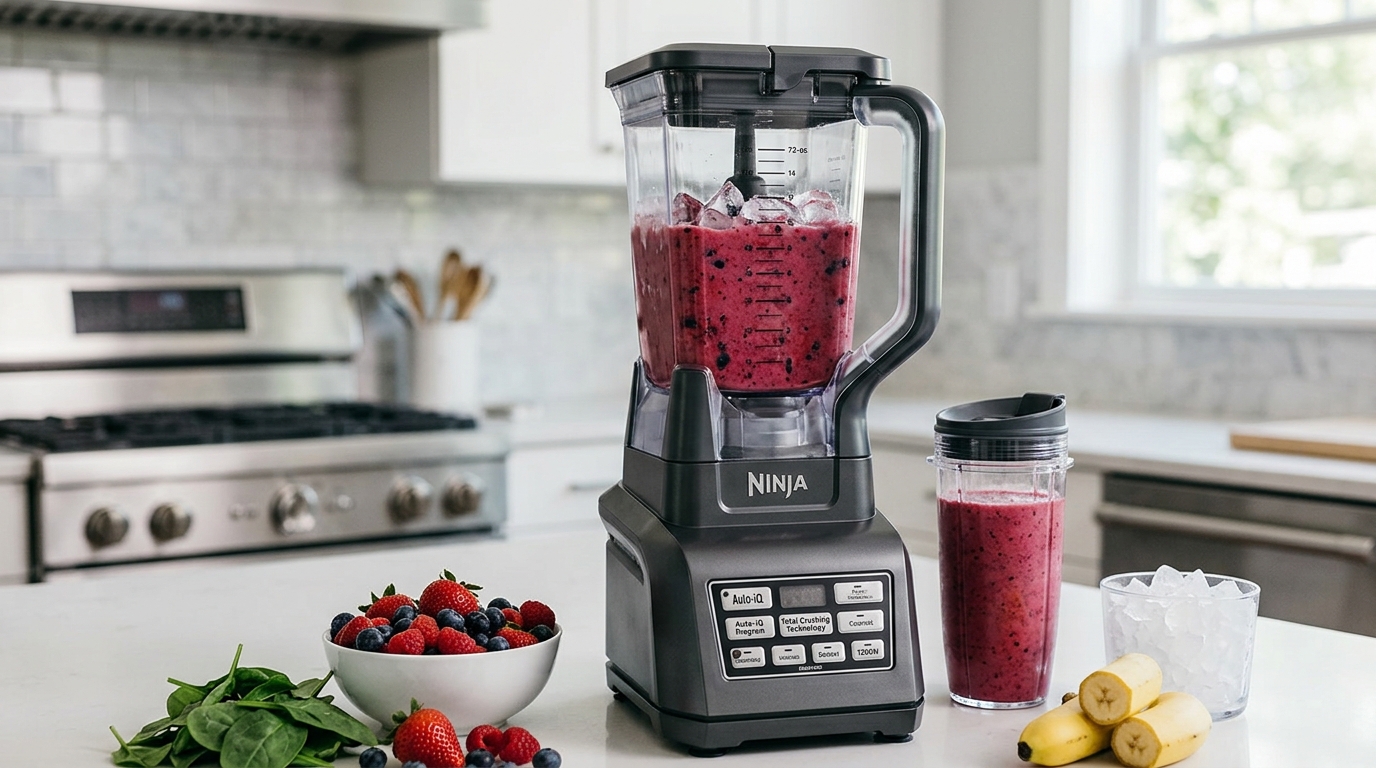
The Ninja Professional Blender 2.0 sits in a category that ends the first story before it starts. At 1,200 watts with Total Crushing Technology and an Auto-iQ intelligent blending program, it’s designed for the household that wants to blend seriously — daily smoothies, frozen drinks, grinding, ice crushing, and more — without the performance ceiling of budget machines or the price tag of commercial-grade equipment. The XL 72-ounce pitcher accommodates batch blending for multiple people, and the dark grey finish works across a range of kitchen aesthetics without demanding visual attention.
What this article aims to do is go beyond the specifications and explore what the Ninja Professional Blender 2.0 actually means in daily use — what it handles well, where its limits sit, who benefits most from owning it, and how it fits into the broader blender landscape.
What Is the Ninja Professional Blender 2.0 BR201AMZ?
The BR201AMZ is positioned in Ninja’s professional blender segment — above the personal and single-serve models, below the ultra-premium lines that approach commercial blender territory in both performance and price. The “2.0” signals an updated generation that adds Auto-iQ intelligent blending programs to the manual speed controls that defined earlier Professional Blender iterations.
The result is a machine with two complementary control approaches: automated programs that handle blending sequence management for specific tasks without requiring user involvement, and manual speed controls plus pulse for situations where hands-on blending technique produces better results than a preset program. This combination gives the BR201AMZ flexibility across both user types — those who want to press a button and walk away, and those who prefer direct control throughout the blending process.
Key Features of the Ninja Professional Blender 2.0
1,200-Watt Motor: What the Power Actually Means
Motor wattage numbers appear in every blender specification, but their practical significance isn’t always obvious. Understanding what 1,200 watts means in real blending situations requires thinking about resistance — specifically, what happens when a blender encounters an ingredient that fights back.
Frozen mango chunks, whole ice cubes, raw almonds, fibrous kale stems, frozen banana — these are the ingredients that expose the gap between capable and incapable blenders. An underpowered motor spinning blades into frozen fruit doesn’t maintain blade velocity through the resistance. It slows. Sometimes it stalls. The result is either extended blending time that warms the ingredients or inconsistent texture where some material is fully processed and other pieces remain in larger chunks.
At 1,200 watts, the Professional Blender 2.0 maintains blade momentum through these challenging ingredients without the slowdown that lower-wattage machines experience. The motor has reserve capacity — it doesn’t have to work at its limit to process frozen fruit or crush ice, which means it maintains consistent performance throughout a blending session rather than laboring toward its ceiling on every challenging ingredient.
This wattage also handles the sustained demands of longer blending sessions — making large batches of smoothies, extended blending for nut butter or hummus — without the heat buildup that strains underpowered motors under comparable sustained load.
Total Crushing Technology: How the Blade System Works
The blade design in any blender is as important as the motor power driving it, because a powerful motor driving an inefficient blade system doesn’t translate its power into effective blending results.
Ninja’s Total Crushing Technology uses a stacked blade assembly — multiple blade tiers at different heights within the pitcher rather than a single cutting surface positioned at the bottom. This multi-level design creates distinct processing zones throughout the column of liquid and ingredients in the 72-ounce pitcher during blending.
In a single-blade blender, the processing zone is concentrated at the bottom. Material at the top circulates in the vortex but must travel down to the blade level before being cut. This creates an inherent inefficiency — the entire pitcher’s contents funnel through one point, which limits throughput and can leave certain ingredients incompletely processed if they don’t reach the blade level consistently.
With multiple blade tiers, material at different heights encounters processing surfaces at their level without needing to migrate entirely to the bottom first. The vortex the spinning creates pulls ingredients continuously through multiple cutting zones rather than one. The practical result is more thorough processing of the entire pitcher’s contents in less blending time, with more consistent particle size distribution — which means smoother smoothies, more evenly crushed ice, and more completely processed fibrous ingredients.
Auto-iQ Intelligent Blending Programs
The Auto-iQ system is what most clearly distinguishes the Professional Blender 2.0 from earlier models that relied exclusively on manual speed control. It consists of preset blending programs that execute predetermined sequences of speed levels, pulsing patterns, and timing — all calibrated through testing to produce optimal results for specific blending applications.
Understanding what Auto-iQ actually does requires thinking about what manual blending technique involves. A skilled blender user making a smoothie with frozen fruit doesn’t just set the machine to high speed and let it run. They might start lower to incorporate air, increase speed to break down frozen ingredients, use pulse bursts to dislodge pieces that aren’t circulating properly, then return to sustained high speed for final smoothing. This sequence isn’t arbitrary — it reflects how ingredients actually behave during blending.
Auto-iQ codifies that technique into preset programs. Select the smoothie program, press start, and the machine executes the appropriate sequence automatically — increasing and decreasing speed, incorporating pulse patterns, running for the calibrated duration — without requiring the user to manage any of it.
The benefit extends beyond convenience. Consistent results emerge from consistent technique, and Auto-iQ produces that consistency automatically regardless of whether the person using the blender has developed smoothie-specific blending intuition. The first smoothie of a new Ninja owner can be as well-processed as the hundredth, because the machine handles the technique rather than the person.
XL 72-Ounce Pitcher: Understanding the Capacity
Seventy-two ounces translates to nine cups — a substantial volume that changes what’s achievable in a single blending session. Understanding why this matters requires thinking about actual serving sizes.
A standard smoothie serving is roughly 16 to 20 ounces. A 72-ounce pitcher accommodates three to four servings in a single blend — a family of four getting their morning smoothies simultaneously without needing to run the blender multiple times while the first batch separates in waiting glasses.
For frozen cocktail preparation during entertaining, the 72-ounce capacity means making pitchers of margaritas or daiquiris for six to eight people in a single blend rather than running multiple cycles while guests wait. For batch smoothie prep — making several servings at once to store for the week — the large pitcher handles meaningful volume in one session.
The pitcher is made from BPA-free plastic rather than glass, which is the standard choice at this capacity level for practical reasons — a 72-ounce glass pitcher full of liquid would be extremely heavy and fragile under the mechanical stress of high-speed blending. The plastic construction maintains clarity for monitoring blending progress while being appropriately lightweight and durable for daily use.
Manual Speed Settings and Pulse Control
Alongside Auto-iQ, the Professional Blender 2.0 maintains manual speed settings and a pulse function that give experienced users direct blending control when the situation calls for it.
Manual control serves applications where Auto-iQ’s predetermined sequences aren’t the right fit. Making a chunky salsa where texture control matters requires different management than smoothie blending — you want to pulse rather than blend continuously, stopping well before the ingredients become fully smooth. Incorporating delicate ingredients that need gentle initial blending before speed increases. Finishing a blend at a specific moment when the texture looks right to the person watching it.
The pulse function delivers full-power momentary bursts — high-speed engagement for exactly as long as the button is held, stopping immediately when released. This is the control tool for breaking up large pieces before sustained blending begins, for controlled processing of chunky ingredients, and for finishing adjustments at the end of a blend.
Together, Auto-iQ and manual controls give the Professional Blender 2.0 range that neither approach provides alone — automated intelligence for everyday blending and manual precision for applications that benefit from user judgment.
Dark Grey Finish
The dark grey exterior is aesthetically considered — neutral enough to fit most kitchen environments, substantial enough to look like quality equipment, and practical enough that the finish doesn’t show every water spot and fingerprint the way bright white or stainless steel surfaces sometimes do. For an appliance that lives on the counter and gets handled daily, these small aesthetic practicalities matter more than they might initially seem.
How the Ninja Professional Blender 2.0 Fits Into Daily Cooking
Morning Smoothies at Family Scale
The scenario the Professional Blender 2.0 handles most naturally is the household that makes smoothies daily for multiple people. Frozen fruit from the bag, fresh spinach, Greek yogurt, milk or a dairy alternative, perhaps some protein powder — all of it goes into the 72-ounce pitcher, the Auto-iQ smoothie program runs, and four glasses’ worth of properly blended, smooth smoothie comes out in one cycle.
The Total Crushing Technology’s multi-blade processing means the spinach is actually blended rather than leaving green leaf fragments. The frozen fruit processes to smooth rather than remaining in pieces that make the smoothie chunky and uneven. The 1,200 watts maintain blade speed through the dense combination rather than bogging down when the motor encounters frozen resistance.
For the household that has been running a smaller, less powerful blender twice or three times each morning to produce enough smoothies for everyone — waiting between batches, dealing with inconsistent results — the combination of capacity and performance the Professional Blender 2.0 provides changes the morning routine in a meaningful way.
Frozen Cocktails and Blended Drinks for Gatherings
Hosting situations are where the 72-ounce pitcher’s capacity advantage becomes most apparent. Making frozen margaritas for eight people with a standard 48-ounce blender requires multiple cycles — which means either batching in advance or making guests wait between rounds. The Professional Blender 2.0’s pitcher handles larger quantities in a single blend.
The ice crushing capability specifically matters for frozen cocktails. Properly crushed ice — fine, even, consistent throughout — produces a properly slushy cocktail texture rather than a mixture of slushy base surrounding large ice chunks that weren’t fully processed. Total Crushing Technology addresses exactly this through its multi-blade processing at multiple heights in the pitcher, encountering ice throughout the column rather than relying on all of it sinking to a single blade level.
Grinding Nuts, Seeds, and Grains
The 1,200-watt motor handles grinding applications that lower-powered blenders can’t sustain — processing raw almonds into almond flour, flaxseeds into ground flax, rolled oats into oat flour for baking, dried spices into powder. These are dry, hard ingredients that require sustained blade contact and adequate motor power to process to the fine consistency that makes them useful as finished ingredients.
The stacked blade design helps with dry grinding by creating processing zones at multiple heights, which matters for keeping dry ingredients in active contact with blades rather than allowing them to settle below a single cutting surface.
Nut butter production is achievable with the Professional Blender 2.0, though it requires more technique than smooth liquid-based blending — roasted nuts, staged processing with pauses to scrape down and allow the motor to cool, and patience through a longer processing time than smoothie making requires.
Hot Soups and Smooth Sauces
Transferring cooked vegetables and broth to the Professional Blender 2.0 for blending into smooth soups is a natural application that the 72-ounce pitcher accommodates in meaningful batch quantities. Butternut squash soup, roasted tomato bisque, carrot ginger soup, and similar preparations blend to velvety consistency efficiently.
Hot liquid blending requires specific technique — filling the pitcher no more than halfway, starting at low speed, and holding the lid firmly — to prevent steam pressure from forcing the lid and causing hot liquid to spray. This safety consideration applies to any blender used for hot liquids and isn’t unique to the Professional Blender 2.0, but it’s worth understanding before attempting it.
Making Homemade Nut Milks
Soaked almonds, cashews, or oats blended with water and then strained through a nut milk bag produces homemade dairy alternatives at a fraction of the cost of commercial versions. The Professional Blender 2.0’s motor processes the soaked nuts finely enough that straining produces a clean, smooth milk with minimal residue, which affects both the quality of the finished product and how much usable milk the batch yields.
For households that consume significant quantities of almond or oat milk, the blender investment pays back relatively quickly through reduced grocery spending on commercial versions.
Smoothie Bowl and Thick Blend Applications
Smoothie bowls — very thick blended fruit mixtures consumed with a spoon rather than drunk — require different blending technique than drinkable smoothies. Less liquid, denser frozen fruit content, the kind of consistency that holds toppings rather than absorbing them. The Professional Blender 2.0’s power handles these thick applications without the motor strain that underpowered blenders experience when liquid content is minimized.
The tamper — a tool that pushes ingredients into the blade zone during blending for thick applications — isn’t always included with blenders at this price level, so thick smoothie bowl blending may require pausing to manually work ingredients toward the blades for some ingredient combinations.
Who the Professional Blender 2.0 Serves Best
Households That Blend Daily for Multiple People
The combination of 72-ounce capacity and 1,200-watt performance is most valuable for households where blending is a regular multi-person activity. A family making smoothies together each morning, a household where multiple people blend independently at different times throughout the day, or any situation where single-serving blending volume doesn’t match actual daily needs — these are the scenarios where the Professional Blender 2.0’s specifications translate into daily quality-of-life improvement.
People Replacing a Frustrating Underpowered Blender
The frustration of an inadequate blender — the inconsistent textures, the multiple blending cycles for a single serving, the motor that strains against frozen fruit — is one of those kitchen irritants that accumulates over time until the decision to upgrade finally gets made. For anyone in that position, the Professional Blender 2.0 represents a performance step up that’s immediately and consistently noticeable from the first use.
Health-Focused Households With Demanding Ingredient Lists
Households that blend daily combinations of leafy greens, frozen vegetables, nuts, seeds, and fibrous fruits — the kinds of nutrient-dense ingredient lists that appear in health-focused eating approaches — benefit most from a machine with both the power to process these ingredients and the blade system to process them thoroughly. A kale smoothie where the kale actually disappears into the blend is a fundamentally different product from one where fragments of leaf remain.
People Who Entertain Regularly
For households that host gatherings where blended drinks — frozen cocktails, large-batch smoothies, blended mocktails — are part of the hospitality, the pitcher capacity is directly relevant to how smoothly that hosting experience goes. Blending for eight people in one cycle rather than three cycles changes the experience for both the host and the guests.
Those Interested in Grinding and Processing Beyond Liquid Blending
For households that want to use a blender for more than smoothies — grinding grains for flour, making nut butter, processing seeds, blending thick hummus — the Professional Blender 2.0’s motor capacity handles these applications where blenders with half its wattage struggle or can’t perform at all.
Important Considerations Before Purchasing
Measuring Counter and Cabinet Clearance First
The 72-ounce pitcher on the motor base creates a taller assembled profile than most people expect from a home blender. Standard kitchen overhead cabinet clearance — typically 18 inches between counter surface and cabinet bottom — can be insufficient for the fully assembled Professional Blender 2.0 in some kitchens. Measuring this clearance before purchasing prevents the common frustration of discovering the blender doesn’t fit under the cabinets where you intended to use it.
If clearance is tight, the pitcher can be stored separately from the base and placed in a different position for use, but this changes the workflow of daily blending enough to be worth knowing before purchase.
The Noise at Full Speed Is Significant
A 1,200-watt motor at full speed blending frozen ingredients produces substantial noise. This is true of all high-powered blenders and isn’t specific to the Professional Blender 2.0, but it’s worth contextualizing accurately. In open-plan living spaces where blending happens in the morning while others are sleeping, or in apartments where noise concerns are particularly relevant, the blending cycle duration — typically 30 to 90 seconds for most applications — is the limiting factor in how disruptive the noise is.
Shorter blending cycles through efficient processing actually help here — the Total Crushing Technology’s thorough processing means ingredients are done faster, which means the loud part of the morning smoothie process is over in less time.
Cleaning the Stacked Blade Assembly
The multi-blade stacked assembly is the feature that drives performance, but it’s also the feature that requires the most care during cleaning. Multiple blade tiers at different heights create cleaning challenges that a single bottom blade doesn’t — reaching all surfaces requires more than a quick rinse.
The most effective everyday cleaning approach is the self-clean method: add a cup or two of warm water and a small amount of dish soap to the pitcher, run the blender on high for 30 to 60 seconds, then empty and rinse thoroughly. This cleans the interior effectively without requiring hand contact with the blade assembly. For more thorough periodic cleaning, disassembling the blade component from the pitcher and washing carefully by hand reaches all surfaces.
Liquid Is Essential for Proper Function
Like all blenders, the Professional Blender 2.0 requires adequate liquid to create the vortex that circulates ingredients through the blade zones. Dry ingredients alone don’t blend — they bounce around the pitcher without the liquid medium that makes proper blending possible. Even applications with predominantly solid ingredients — frozen fruit, ice — need enough liquid to initiate proper blending dynamics.
Not a Full Food Processor Substitute
The Professional Blender 2.0 handles tasks that overlap with food processor functions — grinding, rough chopping, pureeing — but doesn’t replicate a food processor for slicing, shredding, or dough processing. Understanding this boundary helps set realistic expectations about what tasks the blender handles and which still benefit from a dedicated food processor.
How the Professional Blender 2.0 Compares to Other Blenders
Against Ninja’s Own Personal and Single-Serve Models
The fundamental difference between the Professional Blender 2.0 and Ninja’s personal blender line — including the Ninja Fit QB3001SS — isn’t primarily about quality. It’s about scale and purpose. Personal blenders process one serving at a time in a to-go cup. The Professional Blender 2.0 processes three to four servings simultaneously in a pitcher. Both handle everyday smoothie ingredients well, but the personal blender’s capacity ceiling becomes apparent in any situation where more than one person needs a blended drink simultaneously. The Professional Blender 2.0’s 72-ounce pitcher addresses that ceiling directly.
Against Budget Blenders in the 500-700 Watt Range
This is the comparison where the performance difference is most apparent and most consistently reported by people who have experienced both. Budget machines at half the wattage struggle with frozen fruit, can’t crush whole ice cubes reliably, and produce inconsistent textures with fibrous ingredients. The Professional Blender 2.0 handles all of these without the struggle. For households that blend challenging ingredients daily, the performance gap between these categories is significant enough to affect the enjoyment of what the blender produces every single day.
Against Vitamix and Premium High-Performance Blenders
Premium blenders in the Vitamix category operate at 1,500 to 2,200 watts with variable speed control offering extremely fine increments, commercial-grade components built for extreme sustained use, and price points that reflect that engineering investment. They produce the smoothest possible nut butters, the finest possible grain flours, and the most consistent results under all conditions.
The Professional Blender 2.0 doesn’t reach that absolute ceiling — at 1,200 watts with fewer speed increments and consumer-grade construction, it’s a less capable machine for the most demanding applications. For most home households blending smoothies, frozen drinks, and soups, the difference isn’t relevant to daily use. For households at the serious enthusiast end — blending daily, making nut butters regularly, caring deeply about the absolute finest texture possible — the premium blender’s additional capability has more justification.
Against Full-Size Blenders From Other Brands at Similar Price Points
At comparable price points, the competitive landscape includes machines from Oster, Hamilton Beach, Cuisinart, and other established kitchen appliance brands. The specific advantages of the Professional Blender 2.0 within this comparison are the Total Crushing Technology’s multi-blade design, the Auto-iQ intelligent programs, and the 72-ounce capacity — all of which are either absent or less developed in competing options at similar price levels.
Frequently Asked Questions
Can I blend hot liquids safely in the Professional Blender 2.0?
Yes, with important safety precautions. Hot liquids generate steam that creates pressure in a sealed container. Fill the pitcher no more than halfway, remove the center cap from the lid or hold the lid firmly with a folded kitchen towel, start at the lowest speed setting, and gradually increase rather than beginning at high speed. Never fully seal the lid with hot liquid inside. Following these steps makes hot soup blending safe and effective.
How do I get the best results when blending frozen fruit?
Add liquid first — at least half a cup, preferably more — then add frozen fruit on top. The liquid at the bottom initiates the vortex that pulls frozen fruit down into the blade zones rather than leaving it sitting on top. Starting at lower speed to begin the vortex before increasing to high speed produces better results than immediately blending at maximum speed.
Does the Auto-iQ know when blending is complete based on texture?
Auto-iQ programs run calibrated time sequences rather than detecting ingredient consistency in real time. The programs are developed through testing to produce appropriate results for typical ingredient combinations and quantities. For atypical combinations or unusual quantities, the preset timing may produce under or over-processed results, in which case finishing with manual speed control achieves the specific texture desired.
Is the 72-ounce pitcher the only pitcher size available?
The BR201AMZ package includes the 72-ounce pitcher. Other Ninja blender models in the product range use different pitcher sizes, and compatibility between pitchers and bases varies by model line. Checking Ninja’s current compatibility information confirms which accessories work with the Professional Blender 2.0 base specifically.
How long should I expect the motor to last with daily use?
Consumer blender motors are designed for the frequency of typical home use rather than continuous commercial-level operation. With daily household blending of smoothies and typical applications, the motor should last many years. Avoiding prolonged continuous blending sessions that generate significant heat, allowing cool-down between back-to-back blending cycles, and not pushing the motor against resistance beyond its design range — like trying to blend very small quantities of dry hard ingredients without adequate liquid — extends motor life.
Can children use the Professional Blender 2.0 safely?
The blade assembly and high-speed motor require adult supervision and appropriate handling knowledge. The blades are sharp and the motor creates significant rotational force. With appropriate adult supervision and age-appropriate instruction about safe blender handling, older children and teenagers can use the blender safely. Young children should not operate the blender without close adult supervision.
What’s the warranty on the Professional Blender 2.0?
Ninja typically provides a limited warranty on their blender products. Current warranty terms, coverage duration, and the claims process are best confirmed through Ninja’s current official documentation or the product listing, as warranty terms can be updated.
Conclusion
The Ninja Professional Blender 2.0 BR201AMZ makes a well-reasoned case for its place in the kitchen through the combination of three elements that genuinely matter in daily blending: motor power sufficient to handle demanding ingredients consistently, a blade system that processes those ingredients throughout the full pitcher volume rather than at a single point, and intelligent Auto-iQ programs that remove manual technique management from everyday blending applications.
Its 72-ounce pitcher serves households where blending multiple servings simultaneously is a daily reality rather than an occasional need. Its 1,200-watt motor handles frozen fruit, whole ice, and fibrous ingredients without the strain and inconsistency that halve-the-wattage machines produce. Its Auto-iQ programs deliver consistent results automatically for users who want to press a button and walk away.
The overhead cabinet clearance consideration, the noise at full speed, and the cleaning demands of the stacked blade assembly are genuine factors worth knowing about going in. None of them are disqualifying — they’re the practical parameters of a capable appliance that performs significantly better than the alternatives at its price point when the ingredients get challenging.
For households where blending is a meaningful daily habit rather than an occasional kitchen activity, the Professional Blender 2.0 is the kind of appliance that changes how you think about what’s possible at breakfast — and keeps performing that way consistently over years of daily use.