Introduction
There’s a particular kind of kitchen appliance that earns its counter space not through novelty or impressive specifications, but through the simple fact that you reach for it constantly. It becomes part of how you think about cooking — what’s possible on a Tuesday night, how long beans actually need to cook, whether a tough cut of meat is worth attempting on a weekday. The Instant Pot Duo 7-in-1 is that appliance for a remarkable number of households, and the reason isn’t complicated: it does things that genuinely change the cooking experience, and it does them reliably enough that people stop thinking of it as a special-occasion tool and start treating it as the default.
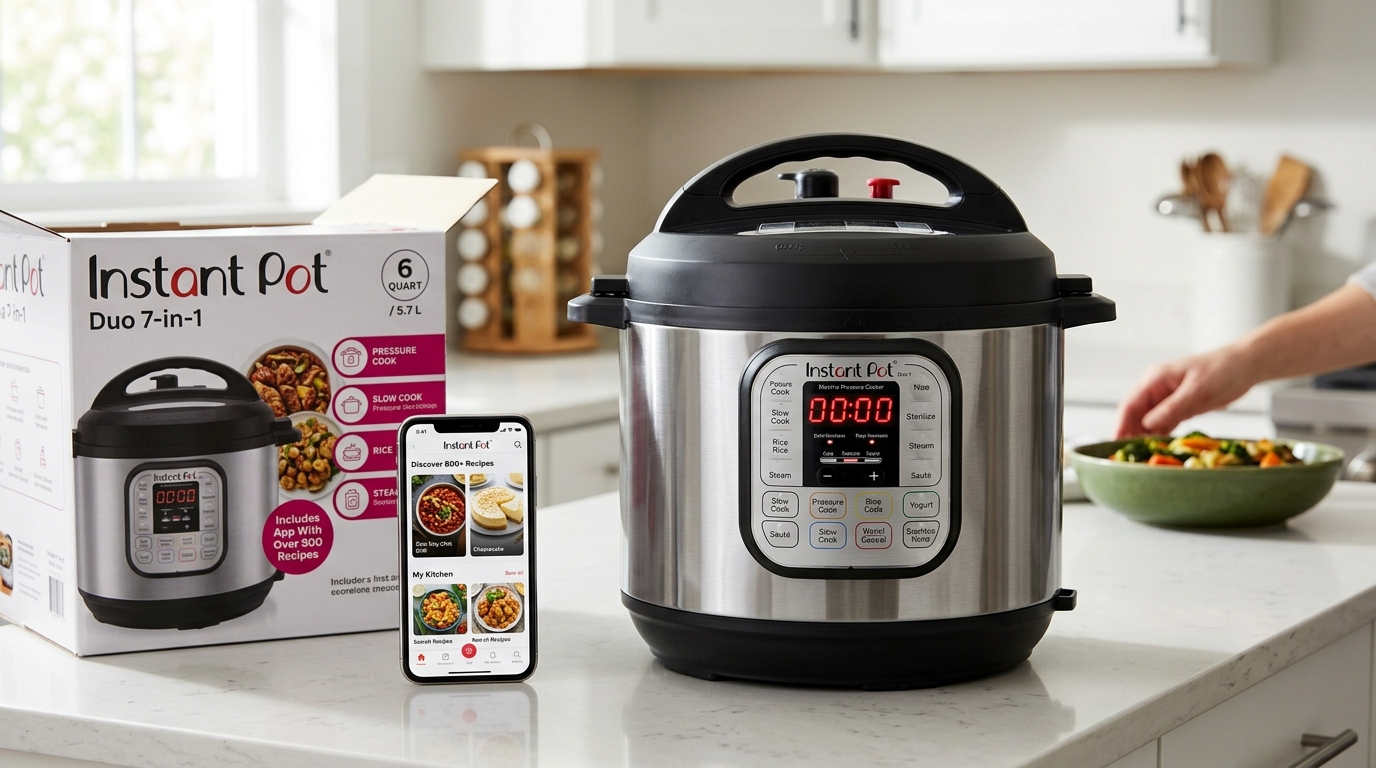
Seven functions — pressure cooking, slow cooking, rice making, steaming, sautéing, yogurt making, and warming — in a 6-quart stainless steel unit that sits on a counter and connects to an app with over 800 recipes. That’s the product description. But the experience of owning one over months and years of regular cooking tells a more interesting story than any spec sheet can capture — one about what happens when cooking time stops being the binding constraint it used to be, when dried beans stop requiring planning ahead, and when weeknight dinners become ambitious enough to include dishes that used to be weekend-only projects.
This article takes a thorough, honest look at what the Instant Pot Duo actually delivers in daily use, who it genuinely serves, and what’s worth understanding before it becomes part of your kitchen.
What Is the Instant Pot Duo 7-in-1?
The Duo is the foundational model in Instant Pot’s lineup — the version that established the category and remains the most widely used electric pressure cooker in North America. It’s a 6-quart electric multicooker that uses a sealed, pressurized cooking environment to raise internal cooking temperatures above the normal boiling point of water, dramatically compressing the time required for foods that would otherwise demand extended conventional cooking.
The stainless steel inner pot is one of its most practically important details — it doesn’t have the PTFE-based non-stick coating that raises concerns for some users, it goes straight into the dishwasher, and it handles high-heat sautéing without the surface degradation concerns associated with non-stick coatings under direct heat. The lid seals completely during pressure cooking and latches securely, with multiple integrated safety mechanisms that prevent the lid from being opened while internal pressure remains.
Seven functions cover a meaningful range of cooking methods. Understanding each one in concrete terms reveals where the Duo’s value actually sits in daily cooking practice.
Key Features of the Instant Pot Duo 7-in-1
Pressure Cooking: The Function That Changes Everything
If there’s a single capability that explains why the Instant Pot category grew so explosively, it’s pressure cooking — and specifically, what pressure cooking does to ingredients and cooking timelines that nothing else achieves as effectively.
The physics are straightforward: sealing the pot traps steam, which builds pressure, which raises the boiling point of water from 212°F to approximately 250°F. That elevated temperature doesn’t just cook food faster in a linear sense — it breaks down collagen in tough connective tissue, softens the bran layer of whole grains, and hydrates dried legumes at rates that change the fundamental economics of what’s worth cooking on a weeknight.
Chuck roast that requires three to four hours of oven braising to become tender takes 60 to 75 minutes under high pressure. Dried chickpeas that need overnight soaking plus an hour of stovetop simmering are done in 40 minutes without pre-soaking. Chicken thighs cooked from frozen to fall-off-the-bone tender take 25 minutes. A whole pork shoulder that would occupy an oven for six hours becomes pulled pork in 90 minutes.
These time compressions aren’t marginal improvements — they fundamentally expand what’s achievable on weeknight cooking schedules and change the financial calculus of using inexpensive, tough cuts of meat that would otherwise require hours of oven time.
The Duo operates at two pressure levels. High pressure handles the vast majority of protein, legume, and grain cooking. Low pressure is reserved for delicate applications — certain fish preparations, eggs, and foods where the temperature ceiling of high pressure would overcook the exterior before the interior is done.
Sauté Function: The Bridge Between Flavor and Convenience
Pressure cooking has one inherent limitation that the sauté function directly addresses: moist heat doesn’t produce browning. The Maillard reaction — the chemical process that creates the caramelized, complex flavors on seared meat and softened aromatics — requires dry, high heat. Braised dishes that start with properly seared meat taste fundamentally different from those where the meat goes into the liquid raw.
The sauté function heats the inner pot to temperatures that allow genuine browning — not just warming, but actual searing. Onions soften and caramelize. Aromatics bloom in oil. A chuck roast develops a proper brown crust before pressure cooking builds the braise around it. Rendered fat from sausage or pancetta coats the pot before vegetables go in.
This capability keeps the entire recipe in one vessel. Without it, building flavor through browning means a separate pan, a transfer of contents to the Instant Pot, and an additional piece of cookware to wash. The sauté function eliminates that step, which is the practical difference between a recipe that’s genuinely one-pot and one that merely finishes in the Instant Pot after starting on the stove.
Three heat levels — less, normal, and more — accommodate different sauté applications. Less suits gentle softening of delicate aromatics. Normal handles most everyday sautéing. More provides the high heat needed for proper searing of proteins.
Slow Cooking: The Patient Alternative
Some dishes don’t benefit from speed. Flavors that develop over six to eight hours of slow, low heat are genuinely different from flavors that develop in 45 minutes under pressure — not worse or better, but different in character. Pulled pork that has spent eight hours in a low-heat environment has a particular texture and flavor integration that pressure-cooked pulled pork, while excellent, doesn’t quite replicate.
The slow cook function covers this cooking style directly, operating at temperatures comparable to a traditional slow cooker and supporting the same range of long-cook dishes. Chili that simmers all day while no one is home. Pot roast that starts in the morning and is ready for dinner. Braised short ribs that have had time to develop the kind of deep, complex flavor that only extended low heat produces.
For households that have used a dedicated slow cooker, the Duo’s slow cook function is a direct replacement — the same cooking approach in the same appliance that handles everything else. One important note: some recipes developed specifically for traditional oval slow cookers may produce slightly different results in the Duo’s round pot, and liquid amounts may need minor adjustment since the Instant Pot’s sealed environment doesn’t allow evaporation the way an uncovered slow cooker lid does.
Rice and Grain Cooking
The rice function handles white rice through an automated cycle that monitors cooking and transitions to warm when done. Results are consistently reliable for standard long-grain and medium-grain white rice — fluffy, properly cooked, ready without monitoring.
Brown rice and other whole grains use the pressure cook function rather than a dedicated grain button, with water ratios and cook times adjusted for the specific grain. This approach works well for most whole grains, though households that cook multiple rice varieties daily and prioritize fine-tuned grain-specific optimization may find a dedicated fuzzy logic rice cooker produces more precisely calibrated results for specialty varieties. For everyday household rice cooking, the Duo’s approach is more than adequate.
Steaming
The included steam rack — a simple trivet that sits in the bottom of the pot — elevates food above water for steam cooking. Vegetables retain texture and nutrients better through steaming than boiling. Fish cooks gently without drying. Dumplings and tamales steam properly in the contained environment.
Eggs steamed under pressure deserve specific mention because the results genuinely surprise most new Instant Pot owners. A 5-5-5 cycle — five minutes to pressure, five minutes cooking, five minutes natural release, then ice bath — produces hard-boiled eggs that peel dramatically more easily than traditionally boiled ones. The shells practically slide off. For households that make hard-boiled eggs regularly, this alone becomes a relied-upon Instant Pot use.
Yogurt Making
Making yogurt at home involves two distinct temperature-dependent stages: heating milk to pasteurization temperature to kill competing bacteria, then cooling and holding it at incubation temperature for eight to twelve hours while the culture works. The Duo’s yogurt function handles both stages with preset temperature programs, removing the need for thermometers and manual temperature management.
The result is plain yogurt that costs a fraction of store-bought equivalents and can be flavored, sweetened, strained to Greek-style thickness, or used as a cooking ingredient. For households that consume significant quantities of yogurt, the financial savings over months of regular home production are substantial. The overnight incubation approach — start the yogurt before bed, refrigerate in the morning — fits naturally into a daily routine without demanding active time.
Keep Warm Function
After any cooking cycle completes, the Duo automatically transitions to keep warm, maintaining food at a safe serving temperature without continuing to cook. For households where dinner timing is unpredictable — someone arriving home later than expected, a meal finishing ahead of schedule — this transition removes the pressure of precise timing. Food holds in keep warm for several hours while retaining acceptable quality, though texture does gradually change over extended hold times.
Companion App with 800+ Recipes
The app provides a structured starting point for new owners navigating an appliance that works differently from any conventional cooking tool they’ve used before. Recipes developed specifically for the Instant Pot include Instant Pot-specific instructions — the terminology, the timing that accounts for pressurization and release, the liquid ratios calibrated for sealed cooking. For someone converting their first conventional recipe to pressure cooking and uncertain how to adjust timing and liquid, the app’s library of tested recipes removes that uncertainty.
How the Instant Pot Duo Changes Daily Cooking in Practice
Weeknight Dinners That Weren’t Previously Possible
The most immediate impact for most new Instant Pot owners is the expansion of what’s achievable on weeknight cooking schedules. Dishes that previously required either extensive active cooking time or an impractically long oven session — beef stew, braised chicken thighs, lentil soup from dry lentils, shredded pork for tacos — become realistic Tuesday dinner options.
This isn’t just about speed in isolation. It’s about what becomes thinkable as a weeknight option when the constraint of long cooking times is removed. Households that previously defaulted to pasta or simple pan-cooked proteins because substantive dishes required more time than an evening allowed start cooking differently once pressure cooking enters the equation.
Transforming the Economics of Grocery Shopping
Cheap cuts of meat are cheap for a reason: they’re collagen-rich and require long cooking times to become tender. Chuck roast, pork shoulder, lamb shank, beef oxtail, chicken drumsticks — these cuts cost a fraction of premium options but produce deeply flavored, satisfying results when cooked correctly. “Correctly” has traditionally meant hours of oven or stovetop time. Under pressure, it means 45 to 90 minutes.
The same transformation applies to dried legumes. A pound of dried black beans costs less than a dollar and produces multiple servings of beans that rival restaurant quality when pressure cooked with aromatics and seasoning. Canned beans at comparable quantity cost several times more. Households that shift to cooking dried beans in the Instant Pot see noticeable grocery cost reductions over time.
Batch Cooking That Actually Happens
Batch cooking is one of those practices that most people theoretically endorse but practically abandon because the time investment feels prohibitive. Spending three hours on a Sunday cooking food for the week is a real commitment that competes with everything else demanding attention on a weekend.
The Instant Pot compresses the time investment of batch cooking meaningfully. A batch of shredded chicken takes 20 minutes. Dried chickpeas for the week are done in 40 minutes. A large pot of stock from vegetable scraps or chicken bones takes two hours where stovetop stock takes four to six. These compressed timelines make batch cooking feel manageable rather than heroic, which means it actually happens consistently rather than as an occasional aspirational project.
One-Pot Cooking That Minimizes Cleanup
The sauté-then-pressure-cook workflow keeps entire recipes in a single vessel. Recipes that conventionally require a sauté pan for browning, a separate pot for braising, and potentially a third vessel for a sauce finish become single-pot operations in the Instant Pot. One pot to wash, one appliance to wipe down, minimal cleanup overhead for dishes that previously generated significant post-dinner kitchen work.
Who the Instant Pot Duo Actually Serves Best
Households Where Time Is the Primary Cooking Constraint
The Duo’s most significant practical contribution is time — specifically, returning time to households that want to cook substantive food from scratch but don’t have hours to dedicate to conventional cooking methods. Working parents, dual-income households, people with demanding schedules who still prioritize home cooking — these are the households where the Instant Pot’s time compression creates the most tangible daily value.
People Who Cook Legumes and Grains Regularly
Vegetarian and plant-forward households, or anyone who incorporates significant quantities of beans, lentils, and whole grains into their diet, benefit enormously from pressure cooking’s effect on these ingredients. Cooking dried beans without pre-soaking in under 40 minutes changes how frequently legumes appear on the weekly menu and how much they cost per serving.
Households on a Tight Food Budget
The combination of making tough cuts of meat tender in reasonable time, cooking legumes from dry efficiently, and producing large batches of soup and stew that stretch across multiple meals makes the Instant Pot one of the more financially impactful kitchen appliances for budget-conscious households. The investment pays back quickly through reduced food spending for households that cook frequently.
Home Cooks Interested in Learning New Techniques
Pressure cooking, sous vide preparation (using the keep warm function as a controlled temperature bath for certain applications), and yogurt fermentation are all techniques that the Instant Pot makes accessible without dedicated single-purpose equipment. For cooks who want to expand what they can make at home without accumulating specialized tools, the Duo provides a meaningful platform for culinary exploration.
Anyone Replacing Multiple Single-Purpose Appliances
A rice cooker, a slow cooker, a steamer, and a yogurt maker — four separate appliances with their own storage requirements — are all replaced by the Instant Pot Duo. For kitchens where cabinet space is limited and appliance accumulation has become a problem, the consolidation the Duo offers has real spatial and organizational value.
Important Things to Consider Before Buying
The Learning Curve Exists and Shouldn’t Be Underestimated
The first several weeks of owning an Instant Pot involve genuine learning. The terminology is specific — natural release, quick release, float valve, trivet — and takes some time to feel natural. Understanding why some recipes require natural release and others work with quick release, how to layer ingredients to avoid the burn notice, and how to adapt conventional recipes for sealed cooking all require experience that builds through use.
Most new owners find comfortable familiarity within two to three weeks of regular cooking. The learning curve exists but is surmountable, and the app’s recipe library provides scaffolded instructions that help significantly during the initial period.
Total Cook Time Is Longer Than the Recipe Says
One of the most consistent sources of frustration for new Instant Pot owners is the gap between recipe-stated cook time and actual elapsed time. A recipe that says “cook for 20 minutes under high pressure” takes 10 to 15 minutes to build pressure before the 20-minute countdown begins, plus whatever release time the recipe requires afterward — natural release for a large liquid-heavy dish can add 20 to 25 minutes.
A “20-minute” recipe can realistically take 50 to 60 minutes from start to serving. This isn’t a flaw — it’s the nature of pressure cooking — but understanding it before the first few cooking sessions prevents the frustration of expecting dinner in 20 minutes and discovering it won’t be ready for another 40.
The Burn Notice Is a Learning Experience
The burn notice — an error indicating the appliance has detected scorching before pressure is reached — is something most Instant Pot owners encounter during the learning period. It typically happens when there’s insufficient liquid, when thick sauces are in direct contact with the heating element at the bottom, or when certain starchy ingredients settle on the bottom of the pot before pressure is established.
Understanding which recipes are prone to burn notice triggers and how to structure them to avoid it — layering sauces above liquid rather than mixing, ensuring adequate thin liquid at the bottom, deglazing the pot thoroughly after sautéing before adding other ingredients — is part of the Instant Pot learning curve that most owners work through within the first month.
Storage and Counter Space
The 6-quart Duo is a substantial appliance with a lid that doesn’t detach in a way that allows very compact storage. Households need a dedicated location — either permanent counter space or accessible cabinet storage that doesn’t require significant reorganization each time the appliance is used. The lid’s size and the attached cord add to the spatial requirements beyond the base unit alone.
Liquid Requirements for Pressure Cooking
Pressure cooking requires a minimum of liquid to generate the steam that builds pressure — generally at least one cup of thin liquid. Recipes with very little inherent liquid, thick sauces, or dry-rub preparations need additional water or broth to function under pressure. Understanding this requirement prevents underfilling situations that either trigger the burn notice or prevent the pot from reaching pressure at all.
How the Instant Pot Duo Compares to Other Cooking Methods
Conventional Oven Braising
For dishes like pot roast, short ribs, and braised chicken thighs that the oven handles beautifully given enough time, the Instant Pot compresses timelines dramatically — 60 minutes for what might take three hours in a Dutch oven. The oven produces slightly more caramelization and browning from the prolonged dry heat exposure that the Instant Pot’s moist pressure environment doesn’t replicate. Both methods produce excellent results; the Instant Pot produces them in a fraction of the time with less hands-on attention and without heating the entire kitchen.
Dedicated Rice Cookers
For white rice, the Instant Pot performs well. For households that cook multiple varieties of rice daily — particularly specialty short-grain varieties for specific cuisines — a dedicated fuzzy logic rice cooker with grain-specific programming may produce marginally more optimized results for those specific applications. For general household rice cooking as one of many weekly tasks, the Instant Pot handles it competently without requiring a separate appliance.
Traditional Slow Cookers
Dedicated slow cookers — particularly large-format oval models — are specifically shaped and calibrated for the low, extended heat of slow cooking. The Instant Pot’s slow cook function performs this same cooking method in the same appliance that handles pressure cooking, trading some optimization for that single function against the benefit of consolidation. For households that primarily want slow cooker functionality, a dedicated model may suit that specific use better. For those who want slow cooking alongside pressure cooking and the other Duo functions, the Instant Pot is the more practical single-appliance solution.
Stovetop Pressure Cookers
Stovetop pressure cookers reach higher pressures than electric models, which means shorter cooking times for equivalent results. They’re also less expensive and have fewer electronic components that can develop issues over time. The trade-off is direct supervision — stovetop models require manual pressure management and can’t be walked away from the way the Instant Pot can. For hands-off cooking that runs without active attention, the electric Duo has a meaningful practical advantage.
Air Fryers
The Instant Pot and air fryer are complementary tools that frequently come up together because both have become popular simultaneously — but they serve fundamentally different purposes. Pressure cooking uses moist, sealed heat. Air frying uses dry, circulating heat to produce crispy results. They don’t compete; households with both cover a broader range of cooking needs than either appliance handles alone.
Frequently Asked Questions
How do I know when the Instant Pot has reached pressure?
The float valve on the lid rises to indicate the pot has sealed and reached pressure. The display transitions from the preheat phase to the countdown timer when active pressure cooking begins. Both visual cues confirm that pressure has been reached and the cooking countdown is running.
Why does my food sometimes taste bland compared to stovetop cooking?
Sealed pressure cooking doesn’t allow evaporation, which concentrates flavors in open-pot cooking. Seasoning that would reduce and intensify on a stovetop stays diluted in the sealed environment. Seasoning more assertively than usual — salt, aromatics, spices — and finishing with fresh herbs, acid, or a brief sauté reduction after pressure cooking addresses this effectively.
Can I halve recipes for the 6-quart Instant Pot?
Yes, though the minimum liquid requirement for pressure cooking remains regardless of recipe size — at least one cup of thin liquid needs to be present. Cooking times generally remain the same for halved recipes since pressure cooking time is determined by ingredient thickness rather than quantity.
What’s the maximum safe fill level?
Two-thirds full for most cooking. Half full for foods that expand significantly during cooking — grains, legumes, foods with leavening. Overfilling prevents proper pressurization and can create safety issues.
Does the Instant Pot work for canning?
Instant Pot specifically advises against using their appliances for home canning. The pressure levels in electric pressure cookers are not consistent enough to meet USDA safety standards for home canning, which requires sustained, verified pressure levels for specific durations. For food safety reasons, canning should be done using equipment specifically designed and tested for that purpose.
How often does it need to be cleaned beyond the inner pot?
The sealing ring on the underside of the lid absorbs odors over time and should be removed and washed after cooking pungent dishes. Replacing it periodically — or having a separate ring for savory and sweet cooking — prevents odor transfer between dishes. The steam release valve and float valve should be checked periodically and cleaned to ensure they operate freely.
Is the stainless steel inner pot scratch-resistant?
Stainless steel is durable and doesn’t scratch as easily as non-stick coatings, but metal utensils used vigorously can leave marks over time. The marks are superficial and don’t affect cooking performance or safety — they’re cosmetic rather than functional. Using silicone or wooden utensils preserves the appearance if that matters.
How long does the Instant Pot typically last with regular use?
With regular use and appropriate maintenance — keeping the sealing ring clean, checking the float valve periodically, descaling occasionally in hard water areas — Instant Pots generally last many years. The sealing ring is the component most likely to need replacement over time and is inexpensive and widely available.
Conclusion
The Instant Pot Duo 7-in-1 has earned its reputation not through marketing or novelty, but through consistent performance across the range of cooking tasks that actually matter in real households cooking real meals on real schedules. Pressure cooking compresses timelines for demanding dishes into weeknight-viable ranges. The sauté function keeps complete recipes in a single pot. Slow cooking handles the long-game dishes that benefit from unhurried heat. Rice, steaming, yogurt making, and warming fill out a functional set that covers the weekly cooking needs of most households.
Its limitations are genuine and worth understanding going in — the learning curve, the gap between stated and total cook time, the burn notice during early use, the storage footprint. None of these are disqualifying; they’re the known parameters of a capable appliance that rewards the investment of learning it properly.
For households that cook frequently and want to expand what’s achievable within realistic time constraints, the Instant Pot Duo represents one of the more impactful single kitchen investments available. The cooking it enables — substantive, from-scratch food using affordable ingredients — is the kind that changes how households think about what’s possible in the kitchen on any given evening.